When this configuration makes sense
- ✓Repeatable parts that qualify for a laser process
- ✓Companies planning to automate welding of thin, precise parts
- ✓Cells that use welding, cleaning or cutting separately
The cobot guides the head, RayTools controls the process, the WLS-2000 provides the source.
The actual configuration combines the Fairino FR5-WML arm with the WLS-2000 unit. Welding, cleaning and cutting are separate operating modes of the unit.
Source power
2000 W
Source
MAXphotonics
Head
RayTools BW101-GS
Arm
FR5-WML / 1900 mm
The laser does not replace MIG/MAG in every task. It makes sense where the part qualifies for the laser process and the geometry repeats often enough for a programmed path to have an advantage over manual guidance.
This is a robotic cell, not a handheld laser welder placed next to the arm. It requires part qualification, a Class 4 laser zone design and separate operator training.
This is not one device with one panel. Four layers are responsible for different things, and this separation determines how the cell is operated.
Welding, cleaning and cutting are three separate configurations of the same unit. You choose one and select the parameters and cell preparation for it.
Mode 01
Joining thin and precise parts. The wire feeder adds filler to the weld where the gap requires it.
Mode 02
Removing rust, mill scale and coatings without mechanical treatment and without abrasive.
Mode 03
Cutting sheet metal within the power range of the unit, along the same programmed path.
The modes cannot be combined in one cycle. Changing the mode means different parameters, different part preparation and a different assessment of the cell.
A Class 4 laser beam is hazardous to the eyes and skin, including after reflection from the part surface. The extent of safeguarding is defined for the specific shop-floor layout, not taken from a catalogue.
The extent of fencing and the windows with laser filter are defined for the cell.
Access interlock while the laser is operating and clear indication that the unit is working.
Laser training is separate from MIG/MAG training.
Safety glasses matched to the wavelength and power of the source.
The Welderstal welding plugin does not control the laser process - that is done by the RayTools software supplied by the head manufacturer.
The scope is stated openly, so that a complete laser cell is not confused with just the unit standing next to a cobot.
These are not two versions of the same solution. They differ in who guides the head, and in what that means for repeatability.
| Criterion | Handheld unit | Robotic cell |
|---|---|---|
| Who guides the head | The operator, by hand | The cobot, along a programmed path |
| Repeatability | Depends on the operator | Repeatable from cycle to cycle |
| Typical use | Short and varied welds, service work | Series with fixed part geometry |
| Preparation | Short deployment | Process qualification and a trial on the part |
| Laser zone | Required | Required, designed together with the cell |
If the welds are short, varied and infrequent, a handheld laser welder is often the more sensible choice. A robotic cell pays off with series production and repeatable part geometry.
The laser is sensitive to edge preparation and fit-up. That is why qualification ends with a trial on your part, not with a claim from a datasheet.
Material and thickness
Type of steel or alloy and dimensions
Weld type
Butt, fillet, lap
Edge preparation
Gap, fit-up and surface cleanliness
Length and path
Weld sections and head access
Batch size
Part repeatability and work rate
Space for the cell
Room for the cobot, the unit and the zone
We build MIG/MAG welding kits on a WS cobot selected for the process. This laser kit works only on the WS-5 WML arm, because that is the configuration with the WLS-2000 unit.
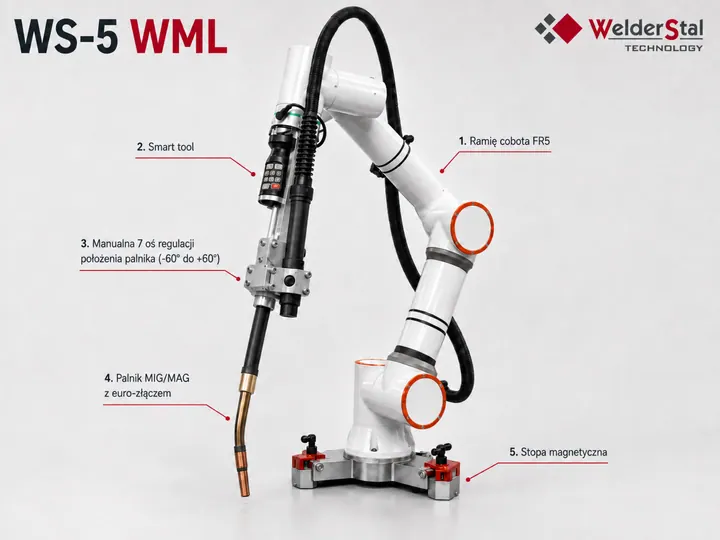
A cell ready for a MIG/MAG unit, without an additional axis.
See the kit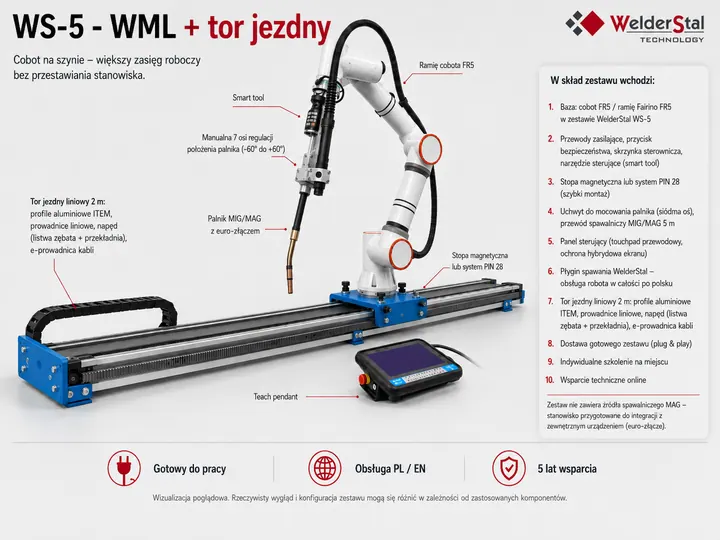
The cobot travels along a long structure or between stations.
See the kit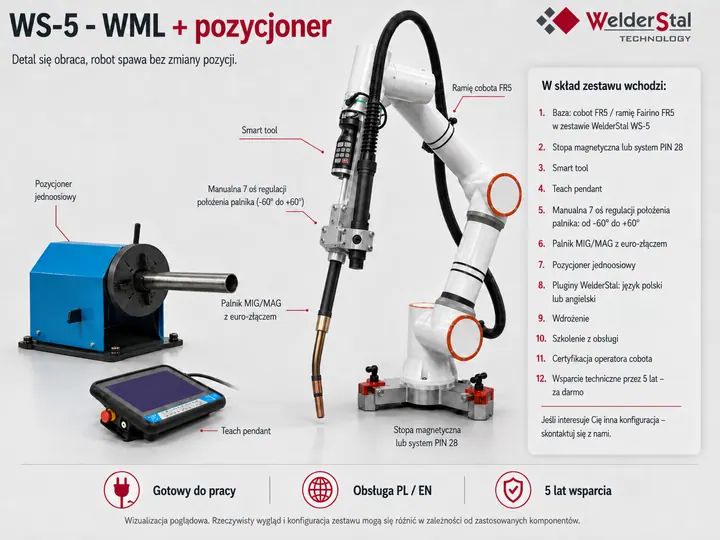
The part rotates in the chuck while the torch keeps a fixed position.
See the kitBased on this we will assess whether the process qualifies for the laser, and propose the scope of the trial and the cell preparation.
Send a part for qualification