Not enough welders
Welders are hard to find and orders are waiting. A cobot can take over repetitive welds and relieve an experienced operator of the simplest, most monotonous work.
If you are short of welders and repetitive parts create a bottleneck - a cobot can take over the monotonous welds. There is one condition: the part, fixturing and weld access have to be prepared for repeatable work. That is why we select the whole WS cell, not just the Fairino / FR arm.
Start
Part and weld
Assessment
Repeatability
Selection
WS cell
Support
Operator
A welding cobot will not work for every part. It makes sense where welding is repetitive and you are short of people and time. Check whether you recognise any of these situations in your plant.
Welders are hard to find and orders are waiting. A cobot can take over repetitive welds and relieve an experienced operator of the simplest, most monotonous work.
The same welds on similar parts are good material for automation. The more repeatable the process, the more reliable the result.
Welding limits throughput, and the pace is hard to maintain on later shifts. A cobot cell helps stabilise the pace of the repetitive part of production.
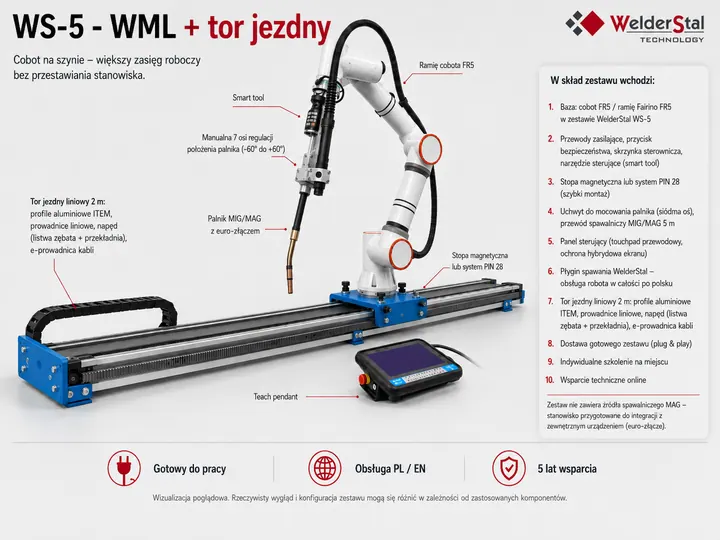
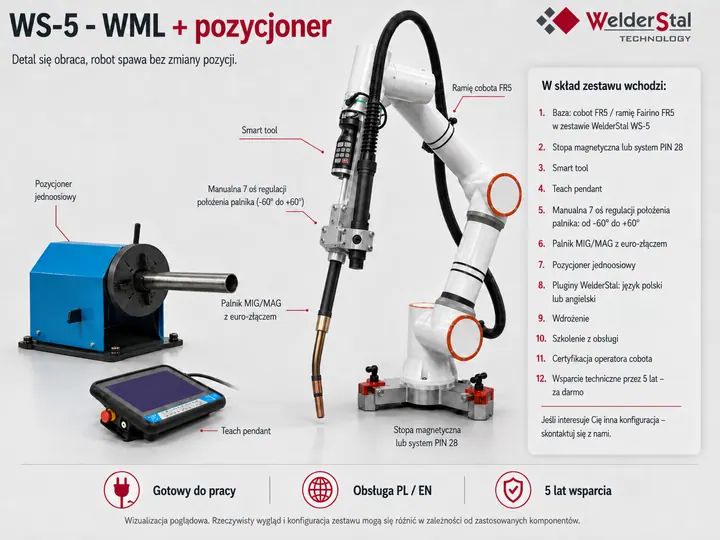
Not every cell has to be designed from scratch. Three welding configurations cover most MIG/MAG processes. What sets them apart is the external axis, i.e. whether the cobot travels to the weld or the part rotates. We build every kit on a WS cobot matched to the process.
The benefits appear when the process is well chosen. We do not promise specific figures without analysing the part - we show what the real advantage of a prepared cell is.
The cobot reproduces the same path and parameters, so on series parts it is easier to keep an even, repeatable result.
The operator does not stand over the simplest, monotonous welds. Their experience stays where it is really needed.
With the Welderstal plugin the operator works with ready points, a sequence and basic parameters instead of programming the cell from scratch.
With repetitive parts, the cell helps maintain an even pace over a longer series, also on later shifts.
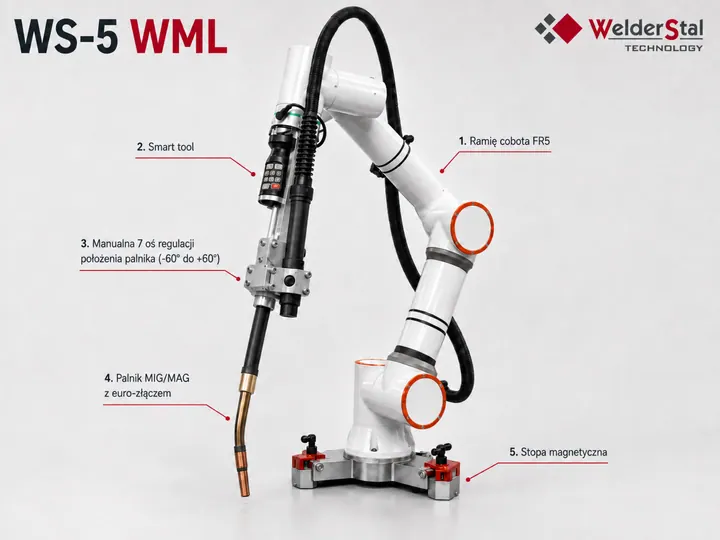
A cobot is a collaborative robot - a welding robot that works close to the operator. The arm alone, however, does not solve part fixturing, weld access, the welding power source or operation. In a kit we put these elements together into one cell.
A WS cell with a matched arm, torch, equipment, program, plugin and training.
We assess the part, weld access, fixturing, positioning and collision risk before defining the scope.
The operator works with ready points, parameters and an operating procedure - they do not program the cell from scratch.
The kit covers selection, configuration, testing, commissioning, training and an agreed scope of support.
We explain the three levels of the offer - the Fairino FR arm, the WS cobot and the kit - in more detail on the page cobots and WS kits.
The Fairino / FR arm alone and the manufacturer’s standard tools.
A WS cell with a matched arm, torch, equipment, program, plugin and training.
You have to prepare the table, fixture and a repeatable part datum yourself or commission an integrator.
We assess the part, weld access, fixturing, positioning and collision risk before defining the scope.
The operator or technical department has to translate the process into a program and motion points on their own.
The operator works with ready points, parameters and an operating procedure - they do not program the cell from scratch.
The arm alone does not solve the choice of power source, torch, safety and training.
The kit covers selection, configuration, testing, commissioning, training and an agreed scope of support.
A good decision does not start with the arm model. It starts with part repeatability, fixturing and weld access.
Send your part for assessmentGood candidate
The part is stable, weld access is repeatable and the torch movement can be described with points and a sequence.
To be checked
The process may make sense, but fixturing, weld access or part variability have to be assessed first.
Sort it out first
If every part needs adjusting by hand, deploying a cobot alone will not solve the quality or repeatability problem.
We most often discuss repetitive production, where the same welds come back on similar parts. These are starting points, not a closed list - we assess your case individually.
Repetitive welds on frames, brackets and structural elements produced in series.
Smaller parts welded in longer series, where even quality and pace matter.
Repetitive circumferential and linear welds on parts with stable geometry.
Plants where the same part comes back regularly and welding is the bottleneck.
We most often discuss MIG/MAG and TIG. The choice of method depends on the part, material and weld requirements - we decide it during the process assessment.
Steel, stainless steel and aluminium have different requirements. What we can actually do on a given part is confirmed after analysis and a trial, not from a catalogue.
You get a cell prepared for work, not just a program screen. We match every element to your part, weld, operator and shop-floor organisation.
The arm, torch, table, part and operation have to be treated as one system.
The operator should work with prepared points and sequences, not recreate the integration from scratch.
We match the model to reach, payload, space at the cell and the way the torch is guided. It is the technical base, not the whole answer to the welding process.
The torch, mounting, cable routing, table, fixture or positioner have to suit the part and weld access.
The part must return to the same place. In some processes a well-prepared fixture matters more than the arm model.
The plugin helps you work with points, sequences and basic process parameters. The scope has to be matched to the specific cell.
We assess the arm motion, tool, part, operator access and the cell surroundings. Safety concerns the whole system.
After the trials, what counts are the corrections, handing the working rules over to the operator and a clear contact path after start-up.
We put every cell together for a specific part and process - describe your case and we will indicate the real scope.
Describe your cellThe videos help you quickly understand the type of applications, but they are not a promise for every part. In the assessment, what counts is the material, geometry, weld access, fixturing and repeatability. The videos are narrated in Polish.
 Video 01
A good video for showing what preparing a welding process on a cobot looks like.
 Video 02
Helps when discussing simpler, repetitive welds.
 Video 03
Useful when discussing the weld type, points and part repeatability.
 Video 04
Supplementary material for assessing whether a similar process makes sense in a given plant.
First we qualify the process. Only then do we select the model, equipment, plugin and commissioning scope.
We collect photos or a video of the part, the material, thickness, weld type, welding method, current problems and the expected result.
We check whether the part can be located consistently, whether weld access is repeatable and what needs a fixture or a positioner.
We select the Fairino / FR arm, torch, equipment, plugin, safeguards, organisation of the operator’s work and the commissioning scope.
We set the points, motion sequence and process parameters and check the result on a real part or a representative sample.
Operators get a ready path for operating the cell, and the technical department knows where to go back for materials and support.
The better you describe the part and the current process, the faster we can assess whether a welding cobot makes sense and what cell scope needs to be planned.
Most important
One photo of the part and a short video of the current welding shorten the conversation more than a long specification. Get in touch and we will receive them by email or arrange it by phone.
A cobot welding station with the same arm can work in a simple layout or in a cell with fixtures, a positioner, a plugin, additional safeguards and broader support. The price follows from the process - four areas affect the cost.
01
Fairino / FR arm, reach, payload, mounting method, table, fixture or positioner.
02
Torch, cable routing, welding power source, communication, signals and parameters.
03
Plugin, points, sequences, organisation of the operator’s work, safeguards and risk assessment.
04
Trials, configuration, operator training, start-up corrections and an agreed scope of support.
Quote = cell scope
Arm + equipment + fixturing + safety + commissioning + support
These answers are meant to qualify the topic for a conversation, not to replace the assessment of the part and the cell.
Not in such a simple sense. The cobot takes over repetitive movements and can relieve the operator on series parts, but you still need a good process, part preparation, quality supervision and a person who understands welding.
A welding cobot is a collaborative robot - a type of welding robot that works close to the operator, usually without full fencing, and is easier to change over. A classic welding robot can be faster in large series, but it needs more space, safeguards and programming. For smaller and varying series a cobot is more often the right fit.
Most often with repetitive parts, series of welds, stable fixturing and a process that can be described with points and a motion sequence. The more improvisation each part needs, the more careful you have to be with automation.
We most often discuss MIG/MAG and TIG. We choose the method for the part, material and weld requirements during the process assessment, rather than assuming it upfront for every case.
Most often steel, stainless steel and aluminium. Each material has its own requirements, so what we can actually do on a specific part is confirmed after analysis and a trial.
It depends on repeatability. Even smaller batches can make sense if the part comes back regularly and can be fixtured consistently. With one-off, very different parts, automation is harder.
It depends on the complexity of the part, equipment, fixturing and the scope of testing. We give a specific date only after assessing the process - before that it would be an empty promise.
It is not possible to give one honest price without a scope. The cost depends on the arm, torch, power source, fixturing, positioner, safeguards, plugin, testing, training and support. That is why we first ask for a description of the part and the process.
We do not claim that without checking the configuration. The version, equipment, application, the operator’s way of working and the technical requirements of the cell have to be verified.
We do not assume so. The aim is to work with prepared points, sequences and parameters with the help of the plugin and training, not to program the cell from scratch.
To start: material, thickness, welding method, weld type, batch size, a description of the fixturing and how the process looks at the cell today. We will receive photos or a video of the part by email or arrange it by phone.
It depends on the whole cell: the arm motion, tool, part, surroundings and the operator’s way of working. Safety is assessed for the complete system, not for the cobot from the catalogue alone.
An investment in a cobot cell may qualify for the robotisation tax relief (Poland). We describe the details and conditions on a separate page and confirm them individually with the customer.
Welding is one of the applications of cobots. If you are considering broader automation or need support after commissioning, start here.
Compare the MAG variant, linear track, positioner and the WLS-2000 laser cell.
An overview of applications and cobot kits, if you are considering more than welding.
How the Welderstal plugin works and what it simplifies for the operator at a welding cell.
Another typical application of WS cobots - placing and palletising products.
Materials, contact and the technical forum after the cell is commissioned.
Preparing operators to work with a cobot at a prepared cell.
Information on the robotisation tax relief (Poland) when investing in a cobot cell.
Describe the part: material, thickness, weld type and your current way of working. We will tell you whether it is worth going further with a WS welding cell, and we will arrange photos and drawings by email or phone.
What to describe