

Stainless steel
- Thickness:
- Thin and medium sheet
- Gas:
- Argon
The small HAZ limits discolouration and helps preserve corrosion resistance.
Do you weld thin sheet and want to do it faster, cleaner and without grinding? We offer a handheld laser welder for metal and aluminium and robotic laser welding. On thin sheet, laser welding is usually faster than TIG, with a small heat-affected zone. We join steel, stainless steel, aluminium, copper and titanium.
Thin sheet
Where the laser excels
0.5–6 mm
Typical range
Clean welds
Less finishing
Tax relief
For robotisation
Laser welding (laser beam welding, LBW) is a metal joining process in which a concentrated laser beam delivers heat directly to the joint. The small-diameter beam melts the base metal and any filler material, forming a weld with high precision and repeatability.
Compared with traditional methods, the laser produces a smaller heat-affected zone (HAZ), which means less distortion and better joint properties - especially on thin sheet.
Process 521
Handheld laser welding is officially process 521 (LBW) under PN-EN ISO 4063. This designation is used to describe the process in welding documentation and on courses that end with a certificate.
Laser operating modes
The beam melts the metal surface without deep penetration. It works well on thin sheet and decorative parts. It produces wide, flat welds with a good appearance.
The beam penetrates the material more deeply, forming a vapour channel (keyhole). It allows greater thicknesses to be welded in a single pass with deep penetration.
A laser combined with a MIG/MAG arc. It combines the speed of the laser with the filling of the arc. Used on thicker material and joints with a larger gap.
When the laser has the advantage, and when a traditional method works better. We set specific parameters for the part.
| Parameter | Laser | TIG | MIG/MAG |
|---|---|---|---|
| Speed (thin sheet) | High | Lower | Medium |
| HAZ | Minimal | Large | Medium |
| Finishing | Often unnecessary | Required | Required |
| Distortion | Minimal | Significant | Moderate |
| Material thickness | Thin and medium | Thin and thick | Medium and thick |
| Shielding gas cost | Low | High (argon) | Medium (mixtures) |
| Weld appearance | Excellent | Very good | Good |
The laser's speed advantage is greatest on thin sheet and shrinks as thickness grows. On thick parts MIG/MAG can be just as productive or better - which is why we only quote speeds after assessing the part.
The videos are narrated in Polish.
Handheld laser welders and accessories. We select the device for the material, thickness and way of working.

Handheld laser welder: precise, clean welds, faster than TIG on thin sheet. Laser welders from WELDERSTAL in Grzawa (Silesia, Poland). Parameters, quotation, delivery across Poland.
Details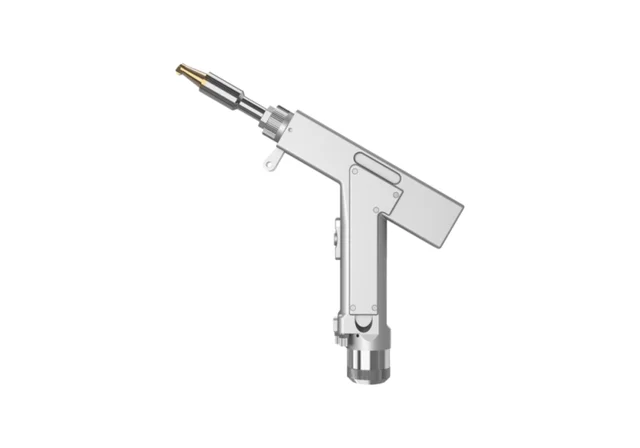
Wires, shielding gases, safety glasses, nozzles and spare parts for laser welders.
See accessories
A cobot for repeatable, multi-shift welding in a WS cell.
See cobotsLaser welders join a wide range of metals, most often in thin and medium thicknesses. We confirm the range for a specific part after assessment.
The small HAZ limits discolouration and helps preserve corrosion resistance.
Clean, neat welds with minimal finishing.
Requires precise heat control - the laser makes this easier. Reflectivity is not a problem for modern sources.
Demanding materials - a concentrated beam and good gas shielding help produce clean joints.
Not sure whether the laser suits your material and thickness? Send us the part - we will assess it and tell you what to expect.
Send a part for assessmentStainless steel tanks, worktops and housings - clean welds without discolouration.
Thin sheet, body panels and components - fast and with little distortion.
3D letters, decorative elements and small metal goods.
Precise joints on heat-sensitive materials, including titanium.
Repeatable series welds on parts with stable geometry.
Repeatable parts where pace and consistent weld quality matter.
The videos are narrated in Polish.
An honest look at the limitations - because choosing a method starts with the part, not the device.
Laser equipment costs more than MIG/MAG. The payback comes with repeatable production and thin sheet.
The laser needs clean, well-fitted edges. A large gap destabilises the process - part preparation matters.
The advantage of the laser shrinks as thickness grows. On thick parts MIG/MAG can be better.
A welding laser is a high-class device - it requires eye protection, a separated zone and a trained operator.
Not sure whether the laser suits your part? Send us a description - we will tell you honestly whether it is the right method, or whether TIG, MIG/MAG or a cobot would be better.
Send a part for assessmentWe do not give a single price, because it depends on the configuration. A handheld laser welder is priced differently from a robotic cell with a cobot. The main factors are below.
01
A handheld laser welder (typically 1000–3000 W) or a cobot with a laser head for automation.
02
Head, wire feeding, shielding gases, cell safeguards and accessories selected for the part.
03
Manual work costs less up front; a robotic cell with a cobot costs more, but works repeatably.
04
Operator training (EN ISO 14732), commissioning, service and support after start-up.
The scale depends on the part and the organisation of work - we prepare an exact calculation individually.
Laser welders and cobots with a laser head may qualify for the robotisation tax relief (a Polish tax incentive). Confirm the scope of the deduction and whether the rules are still current with a tax adviser - we help gather the information you need.
See the relief detailsWant a specific quotation? Send us a part or describe the process - we will select the device and price the cell for your case.
Request a quotationA laser welder is a Class 4 device. When procedures are followed it is a safe production technology - the key points are eye protection, a separated zone and a trained operator.
Laser welders are Class 4 devices. They require a separated, marked work zone and a trained operator.
Mandatory safety glasses/goggles matched to the wavelength of the source (to the relevant eye protection standards).
Protective clothing and extraction of welding fumes and vapours at the cell.
The operator should hold qualifications (EN ISO 14732) and know the procedures for working safely with a laser.
 Video
We test in practice how safety glasses cope with a laser beam - which is why eye protection is the foundation of working with Class 4. The video is narrated in Polish.
Answers to questions about the technology, materials, cost and safety.
It depends on the application. Laser welding wins on thin material, when speed, weld appearance (less grinding) and low distortion matter. MIG/MAG is usually better on thicker sheet, for field welding and where a lower entry cost matters.
Process 521 is the designation for manual laser beam welding (LBW) under PN-EN ISO 4063. This number is used to describe the process in welding documentation and on courses that end with a certificate, among other places.
Laser welders work best on thin and medium sheet. On thicker parts the advantage of MIG/MAG grows. We confirm the maximum range for a specific part after assessment - it depends on the material, source power and weld type.
Higher power allows thicker material to be welded and faster work, but it is not the only factor. The choice of power depends on the material, thickness, weld type and way of working. We help select the device based on a description of the part.
Lasers weld mild steel, stainless steel, aluminium, copper, titanium and nickel alloys, among others, most often in thin and medium thicknesses. The laser handles heat-sensitive materials well. We confirm the range for a part after assessment.
On thin sheet, laser welding is usually faster than MIG/MAG. The advantage shrinks as thickness grows, and on thick parts MIG/MAG can be more efficient. Specific values depend on the material, thickness, weld type and device configuration.
The main limitations are a higher entry cost, the need for clean, well-fitted edges (low gap tolerance), a smaller advantage on thick material and strict health and safety rules (laser Class 4). On repeatable, thin parts these limitations usually do not matter.
Laser welders are Class 4 devices. Safe work requires eye protection, a separated and marked zone, fume extraction and a trained operator. When procedures are followed, it is a safe production technology.
The HAZ (Heat Affected Zone) is the zone around the weld affected by heat. Laser welding produces a clearly smaller HAZ than MIG/MAG, which limits distortion and helps maintain dimensional tolerances. The size of the difference depends on the material and parameters.
The price depends on the power of the device, the equipment, the level of automation and the scope of deployment. Handheld laser welders cost less than a robotic cell with a cobot. We prepare a quotation once the specification is agreed and tell you about the possible robotisation tax relief.
Yes - laser welding requires qualifications to EN ISO 14732. WELDERSTAL runs laser welder training (process 521) that ends with a certificate.
Laser welders and cobots with a laser head may qualify for the robotisation tax relief (a Polish tax incentive). The scope of eligible costs and whether the rules are still current are best confirmed with a tax adviser - we help gather the information you need.
WS-5 WML + WLS-2000: a complete cell with a cobot for a repeatable process.
Practical training and a certificate to EN ISO 14732 (process 521).
Certification and qualifications for welders.
Complete cells: MIG/MAG welding, linear track, positioner, laser and palletising.
Check whether the purchase of a laser welder may qualify for the relief.
Fibre laser, 50 W, with a handheld head: permanent markings on stainless steel and aluminium.
Wires, gases, safety glasses, nozzles and spare parts.
Videos, FAQ and PDF catalogue before a conversation about deployment.
Send us a part or describe the process - we will select the device and prepare a quotation. Based in Grzawa (Silesia, Poland), with delivery and training across Poland.


