01
Cell mechanics
Arm, reach, payload, mounting method, table, fixture or external axis.
Five ready-made cells: MIG/MAG welding, laser processes and palletising.
Each kit is a ready-made cell: arm, base, process equipment, plugin, delivery, commissioning, operator training and technical support. What sets them apart is what they do with the part - whether the cobot travels to it, whether the part rotates, which process joins the material and what the line ends with.
Describe your process and we will match a kit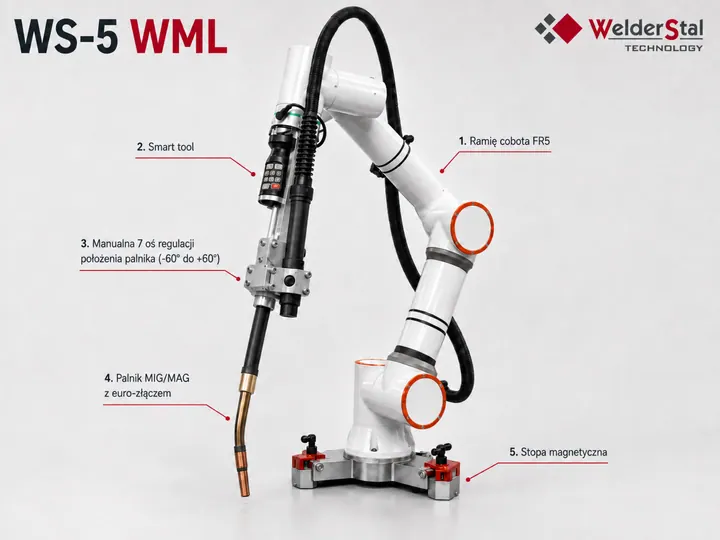
Repeatable parts that fit within the arm’s working envelope.
See the kit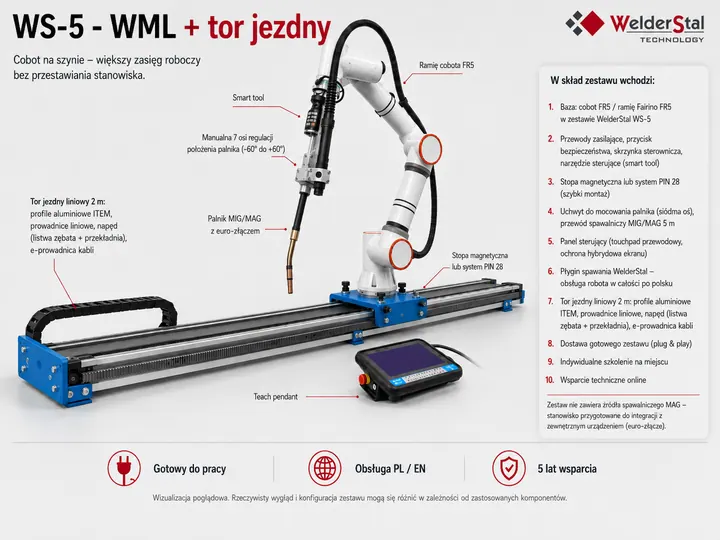
Long structures or several workstations in one line.
See the kit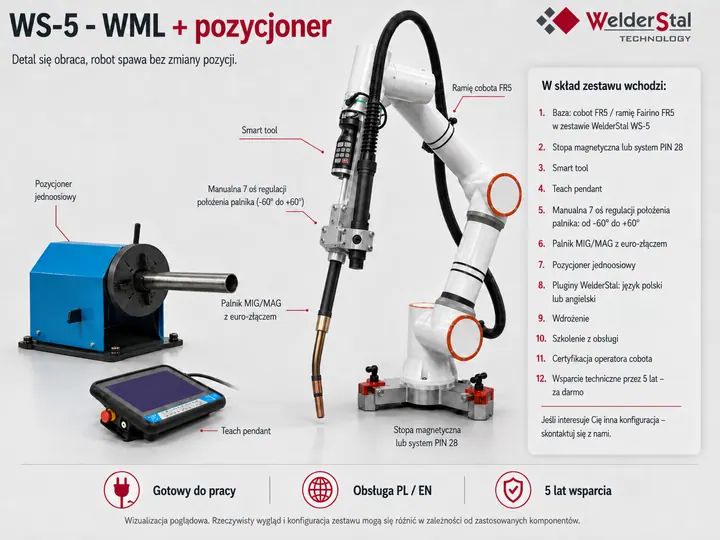
Circumferential welds on pipes, sleeves and shafts.
See the kit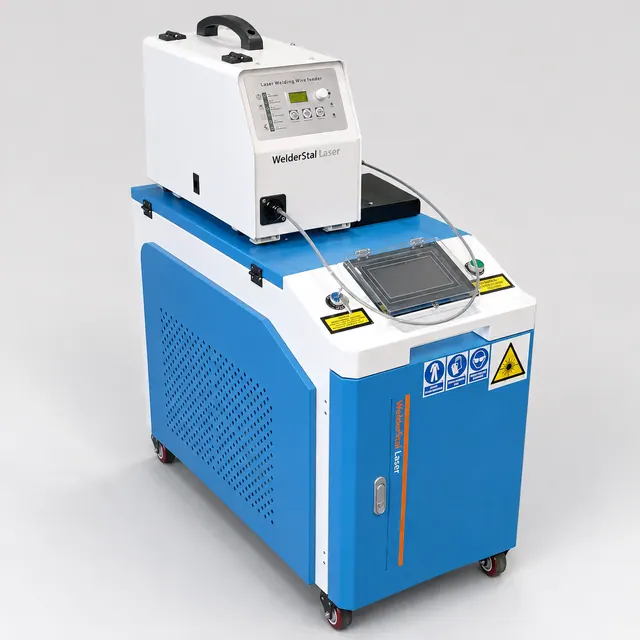
A process qualified for laser: welding, cleaning or cutting.
See the kit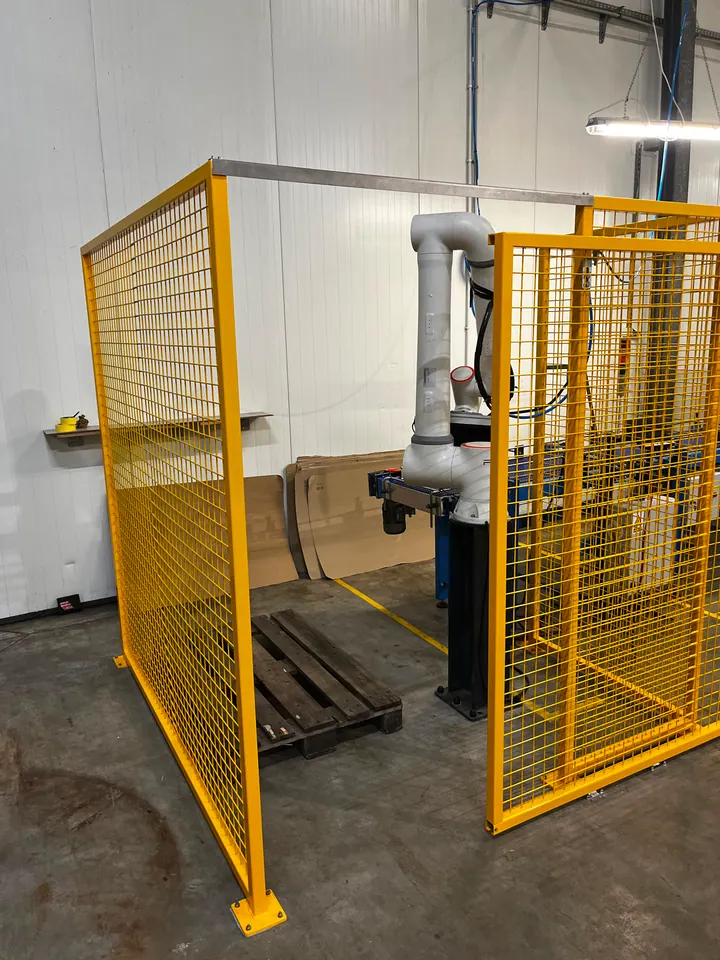
Stacking cartons, bags and containers from the end of the line onto a pallet.
See the kitAny cobot in the WS family fits the welding kit. We match the model to the part, reach and cycle time - the rest of the kit stays the same.
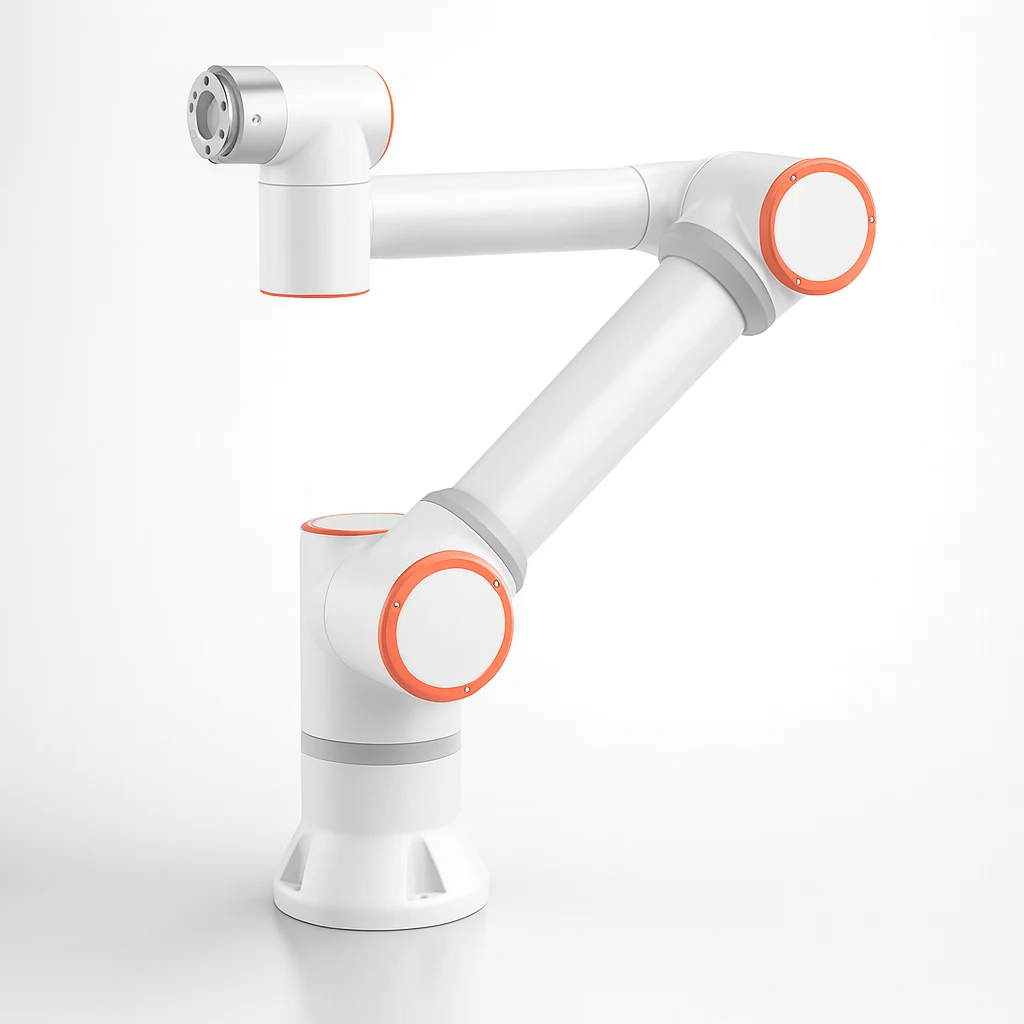
WS-3
Fairino FR3
Magnetic foot or PIN 28
WS-3 WMS
Fairino FR3-WMS
PIN 28 system
WS-3 WML
Fairino FR3-WML
PIN 28 system
WS-5
Fairino FR5
Magnetic foot or PIN 28
WS-5 WML
Fairino FR5-WML
PIN 28 system
WS-10
Fairino FR10
PIN 28 system
WS-16
Fairino FR16
PIN 28 system
WS-20
Fairino FR20
PIN 28 system
WS-30
Fairino FR30
PIN 28 system
The longer the arm, the greater the moment on the cobot base. A magnetic foot is only an option for short arms - WS-3 and WS-5. We supply the other models on PIN 28 locating pins: after relocation the cobot returns to the same base and the program needs fewer corrections.
The choice starts with the part geometry and the space on the shop floor, not with the arm parameters. The table shows what each kit is for.
| Kit | When it makes sense | What we add |
|---|---|---|
| Basic kit | Repeatable parts that fit within the arm’s working envelope. | No additional axis |
| WS kit + linear track | Long structures or several workstations in one line. | External 2 m linear axis |
| WS kit + positioner | Circumferential welds on pipes, sleeves and shafts. | External rotary axis |
| Laser welding kit | A process qualified for laser: welding, cleaning or cutting. | Separate architecture and training |
| Palletising kit | Stacking cartons, bags and containers from the end of the line onto a pallet. | Column-mounted cobot, guarding and conveyor |
The welding kits differ in their external axis, but they share a common base. The palletising kit has different contents - we describe its scope on a separate page.
See the palletising kitThe order is always the same and starts with the part, not with the arm parameters. The answer to the first question usually narrows the choice to two kits, and the next ones settle the rest.
01
If so, the basic kit without an additional axis is enough. If the structure is longer than the arm’s reach or you work at several stations in one line, you need a linear track.
Basic kit or kit with a linear track02
Circumferential welds on pipes, sleeves and shafts are a job for a rotary axis. The part rotates under the torch instead of forcing the arm to travel all the way around it.
WS kit + positioner03
MIG/MAG is handled by the welding kits. If the process has been qualified for laser, the cell architecture and operator training are different, because safety when working with the beam comes into play.
Laser welding kit04
Stacking cartons, bags and containers onto a pallet is a separate task. We build the palletising kit on the WS-20 cobot, with a gripper matched to the product, guarding and a conveyor.
Palletising kitWe do not give one price without a scope, because the same cobot works differently in a simple cell and in a layout with an external axis, fixtures and wider support. The cost is made up of four areas.
01
Arm, reach, payload, mounting method, table, fixture or external axis.
02
Process tool, cable routing, power source, communication and parameters.
03
Plugin, sequences, organisation of the operator’s work, safeguards and risk assessment.
04
Trials, configuration, operator training, start-up corrections and the scope of support.
If you are looking for the arm alone rather than a whole cell, start with the overview of Fairino cobots and WS models. If you are interested in welding automation as a process, we describe it on the welding cobot as a ready-made cell page.
Describe the part, material, batch size and the space at the cell. We will tell you which kit makes sense - and if none does, we will say so plainly.
Describe your process and we will match a kit