When this configuration makes sense
- ✓Circumferential welds on pipes, sleeves and axial parts
- ✓Parts that need smooth rotation while the torch is guided
- ✓Batches where stable clamping shortens changeover
The part rotates, the cobot welds without changing position.
An external rotary axis positions the part during welding and helps keep a favourable torch position on circumferential welds. We match the WS cobot model to the kit - any model in the family fits. Selection depends on the mass, diameter, centre of gravity and weld path, not only on the chuck range.
Chuck range
Ø10–300 mm
Axis type
Rotary, 1 axis
Arm payload
3–30 kg
Arm reach
622–1900 mm
Pipes, sleeves, shafts and flanges with circumferential or longitudinal welds. The self-centring chuck rotates the part relative to the torch, so the welding angle and speed stay constant around the whole circumference, without re-setting the cell between stages.
The board shows the course of the process. Below is what decides whether that course can be repeated on your part.
The Ø10–300 mm chuck range is not a full qualification. Mass, torque, centre of gravity, length and the way the part is supported must be checked.
The board shows where each component sits in the kit. The list below is the delivery scope - stated openly, so that a complete cell is not confused with the cobot arm alone.
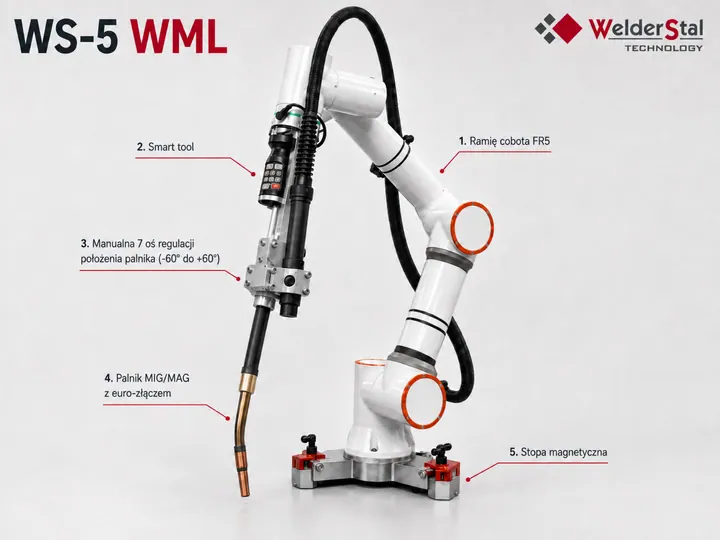
The positioner stabilises the rotated part, but the cell geometry also depends on how the cobot itself is set up. The base follows from the chosen arm.
The kit with the WS-5 WML arm works on PIN 28 locating pins - with a reach of 1900 mm, a magnetic foot does not hold the cell base. The kit with the WS-5 can also use a magnetic foot, which can be moved to another steel surface without tools. We show both variants on the basic kit page.
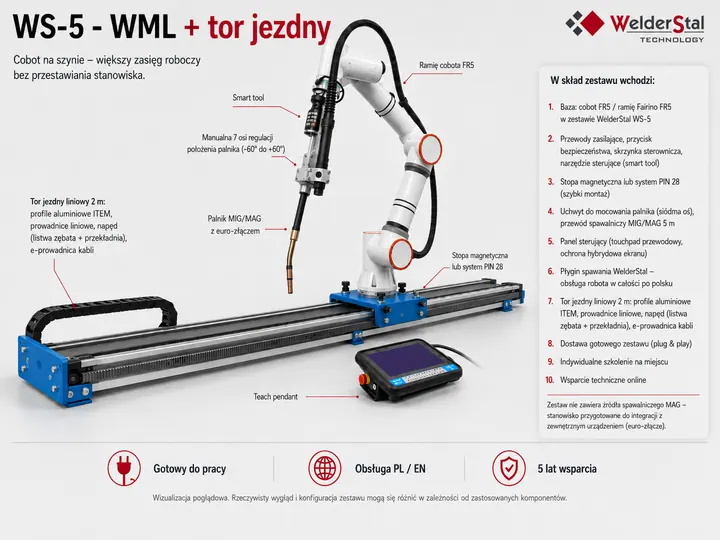
Both configurations add an external axis to the cell, but they solve a different problem. The difference comes down to what has to move: the cobot or the part.
| Criterion | Linear track | Positioner |
|---|---|---|
| What moves | The cobot along a linear axis | The part on a rotary axis |
| Typical part | Long structures, several stations in one line | Pipes, sleeves, shafts, flanges |
| Effect on the process | Larger working area along the axis | Welding without re-clamping between sides of the part |
| Mechanical base | ITEM profiles, toothed rack and gearbox | Self-centring chuck Ø10–300 mm, continuous rotation |
| Control integration | Synchronised with the robot controller | Synchronised with the robot controller |
Both versions are based on the same arm and the same Welderstal welding plugin (Polish/English), so the choice does not change how the cell is programmed. The difference concerns only the process geometry.
Based on these six pieces of information we check the chuck range, the axis orientation and torch access to the whole weld.
Diameter and length
Dimensions of the rotated part
Part mass
Including the clamping fixture
Centre of gravity
Distance from the axis and from the chuck
Weld path
Full circumference or selected sections
Clamping method
Datum surfaces and tolerances
Material and process
Thickness, weld type, MAG parameters
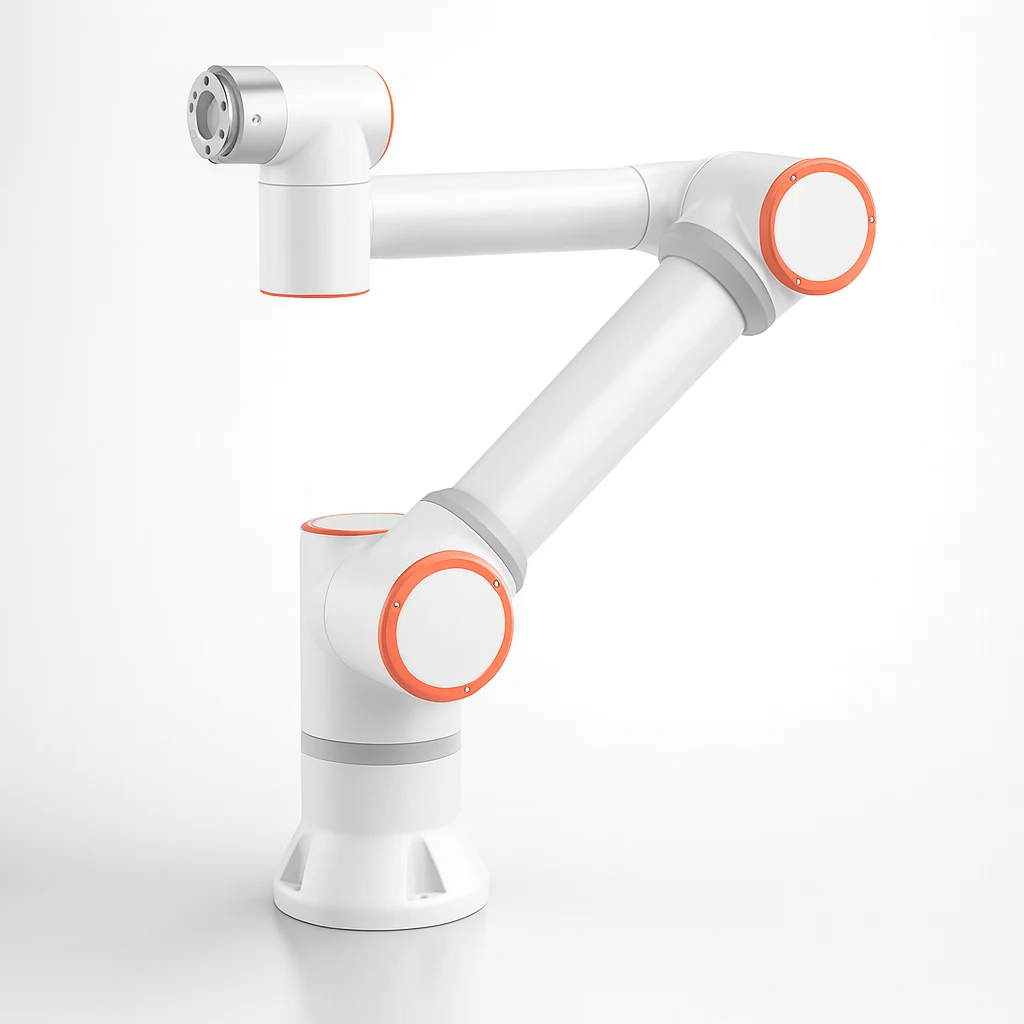
Any cobot in the WS family fits the welding kit. We match the model to the part, reach and cycle time - the rest of the kit stays the same.
WS-3
Fairino FR3
Magnetic foot or PIN 28
WS-3 WMS
Fairino FR3-WMS
PIN 28 system
WS-3 WML
Fairino FR3-WML
PIN 28 system
WS-5
Fairino FR5
Magnetic foot or PIN 28
WS-5 WML
Fairino FR5-WML
PIN 28 system
WS-10
Fairino FR10
PIN 28 system
WS-16
Fairino FR16
PIN 28 system
WS-20
Fairino FR20
PIN 28 system
WS-30
Fairino FR30
PIN 28 system
Give us the dimensions, mass, clamping method and where the weld runs. Based on this we will check the chuck range, the axis orientation and the data needed for a process trial.
Send part data for selection