Skip to content
Collaborative robots and WS kits

Fairino cobots and Welderstal WS kits

Looking for a welding cobot as a ready-made cell? The offer has three levels. The Fairino FR arm is the technical base. The WS cobot is the arm with equipment, a plugin and commissioning, ready to work. The kit is the whole cell: a WS cobot plus the process tool, an external axis or line equipment. We start from the process and match the level to the task.

Start

Process

Selection

FR model

Scope

Equipment

Deployment

Training

How a Fairino FR cobot arm differs from a WS cobot

A Fairino FR arm on its own does not yet solve a production problem. A cell starts to make sense only when the arm is joined by a tool, equipment, a program, safety, training and support.

Bare Fairino FR arm

Fairino FR arm

Welderstal WS kit

WS model selected for payload, reach, pace and workspace

Bare Fairino FR arm

Basic tool or gripper

Welderstal WS kit

Holder, gripper, fixturing, positioner, table or other cell components

Bare Fairino FR arm

Programming on your own

Welderstal WS kit

Process configuration, Welderstal plugins and handover to the operators

Bare Fairino FR arm

Integration on your own

Welderstal WS kit

Commissioning, tests, training and support after start-up in an agreed scope

Bare Fairino FR arm

Safety assessed only on the shop floor

Welderstal WS kit

Assessment of the cell, tool, product, operator movement and required safeguards

What a ready-to-work WS cobot consists of

The Fairino FR arm is the technical base. A WS cobot is the result of a series of deployment decisions: selecting the arm, tool, equipment, plugins, safety, training and support after start-up.

Naming

Fairino FR
The cobot arm alone - the technical base.
WS cobot
The arm with equipment, a plugin and commissioning. Ready to work.
Kit
The whole cell: a WS cobot plus the process tool, an external axis or line equipment.
01 Arm selection

Fairino / FR as the base of the WS cobot

We select the Fairino FR arm for payload, reach, space at the cell and the specific task. In the Welderstal WS offer it is the base of the cell, to which we add the tool, equipment, configuration and commissioning scope.

03 Cell equipment

Fixtures, table, positioner or travel axis

The cell has to hold the part, product or package in a repeatable position. A larger working range adds fixtures, positioners, tables or axis drives.

05 Safety

Assessment of the cell and the safeguards needed

We check the motion of the Fairino FR arm, the tool, the product, operator access, the cell surroundings and whether the process requires additional safeguards.

Does a cobot make sense in your process?

A cobot works best in repeatable tasks that can be described and checked against technical data. Before we choose a model, we collect information about the product, pace, cell and the way it will be operated.

01

Process

A cobot works best where the task is repeatable, can be described in steps and does not need constant operator intervention.

02

Part or product

We need weight, dimensions, tolerances, the gripping surface, stability and whether the format changes often.

03

Cell

We check the space, reach, operator access, how the item is fed in, how the finished product is taken away and possible collisions.

04

Equipment

An arm alone cannot do the job without a tool: torch, gripper, holder, fixture, table, positioner or integration components.

05

Safety

We do not automatically assume operation without guarding. Safety is assessed for the whole cell: motion, tool, product and surroundings.

06

Operation

It must be agreed who changes programs, who changes over the cell, who responds to a stop and what support looks like after commissioning.

The application determines the model

A cell is selected differently for welding, differently for palletising, and differently again for placing parts or tending a machine. We choose the Fairino FR arm as the base of the WS cobot only after defining the application, the tool and the working conditions.

01
Welding

Welding cobot

Repeatable parts, series of welds, work at a table, fixture or positioner. First we check the part, access to the weld, fixturing and whether the process can be held at a repeatable point.

Example: MIG/MAG and TIG on repeatable parts

See welding cobots
02
Palletising

Palletising cobot

End of line, cartons, shrink packs, crates, containers and products stacked in layers. The key factors are weight, gripping, pace, stack height, space at the line and format variability.

Example: Cartons and shrink packs at the end of the line

See palletising
03
Pick-and-place

Packing and placing

Moving parts between stations, placing them into packaging and simple repeatable operations. Here the gripper, the stability of the item and the operator’s rhythm matter most.

Example: Placing parts after an operation

Describe your process
04
Machine tending

Machine and cell tending

Loading and unloading parts in repeatable operations. We verify access to the machine, the fixturing method, cycle time and whether the cobot will get in the operator’s way.

Example: Loading and unloading parts

Ask about selection

We select the Fairino FR arm as the base of the WS cobot

The base of a WS cobot is a selected Fairino FR arm. Payload and reach help narrow down the choice, but they are not enough for a decision. The tool, fixturing, space at the cell, safety and the way the operator works with it also count.

01

Task

What the cobot is to do at the cell

02

Tool

Torch, gripper, fixture or other equipment

03

WS cobot

An FR arm selected for the working conditions, with equipment and commissioning

Arm selection - WS cobots and Fairino FR bases

The parameters help narrow down the choice.

WS-3
Welderstal WS cobot
Arm base: Fairino FR-3

When to consider

Small parts, welding cells, trials, operator training and light tools.

FR arm parameters

3 kg payload 622 mm reach ±0.02 mm
See the cobot
WS-5
Welderstal WS cobot
Arm base: Fairino FR-5

When to consider

Light production tasks, welding, placing parts and simple auxiliary cells.

FR arm parameters

5 kg payload 922 mm reach ±0.02 mm
See the cobot
WS-10
Welderstal WS cobot
Arm base: Fairino FR-10

When to consider

A versatile range for welding, packing, cell tending and medium-sized parts.

FR arm parameters

10 kg payload 1400 mm reach ±0.05 mm
See the cobot
WS-16
Welderstal WS cobot
Arm base: Fairino FR-16

When to consider

Heavier tools, larger parts and cells that need payload headroom.

FR arm parameters

16 kg payload 1034 mm reach ±0.03 mm
See the cobot
WS-20
Welderstal WS cobot
Arm base: Fairino FR-20

When to consider

Palletising, end of line, longer reach and work with products stacked in layers.

FR arm parameters

20 kg payload 1854 mm reach ±0.1 mm
See the cobot
WS-30
Welderstal WS cobot
Arm base: Fairino FR-30

When to consider

The heaviest tasks in the WS family, requiring high payload and rigid mounting.

FR arm parameters

30 kg payload 1403 mm reach ±0.1 mm
See the cobot
WS-5
Welding kit arm
Arm base: Fairino FR5-WML

When to consider

Welding with a 1900 mm arm reach; MAG variant, linear track, positioner or WLS-2000.

FR arm parameters

5 kg payload 1900 mm reach ±0.1 mm
See the kits
WS-3
Welderstal WS cobot
Arm base: Fairino FR-3

When to consider

FR arm parameters

3 kg payload 622 mm reach ±0.02 mm
See the cobot
WS-3
Welderstal WS cobot
Arm base: Fairino FR-3

When to consider

FR arm parameters

3 kg payload 922 mm reach ±0.05 mm
See the cobot
WS-5
Welding kit arm
Arm base: Fairino FR5-WML

When to consider

Welding with a 1900 mm arm reach; MAG variant, linear track, positioner or WLS-2000.

FR arm parameters

5 kg payload 1900 mm reach ±0.1 mm
See the kits

This is not a price configurator. We choose the final model only after checking the task, tool, fixturing, product, pace and safety requirements.

How the work goes from idea to commissioning

Good automation does not start with a catalogue. It starts with checking the process, the risks and the data that decide whether a cobot will really make the work easier.

1 Step

Process assessment

We collect a process description, photos or a video, basic part parameters, pace and cell constraints.

2 Step

Concept selection

We check whether the task suits a cobot, which FR model is the right base for the WS cobot, which tool will be needed and what has to be tested before a decision.

3 Step

Equipment and plugins

We select the gripper, holder, fixturing, table, positioner, safeguards and plugins that make operation easier for the operator.

4 Step

Commissioning

We prepare the cell, configure the cobot, run trials and adjust the parameters to real conditions.

5 Step

Training

Operators learn the basics of operation, changeovers, responding to a stop and the rules for working with the prepared cell.

6 Step

Support after start-up

After commissioning, corrections, technical answers, materials, the forum and a clear contact path to service all matter.

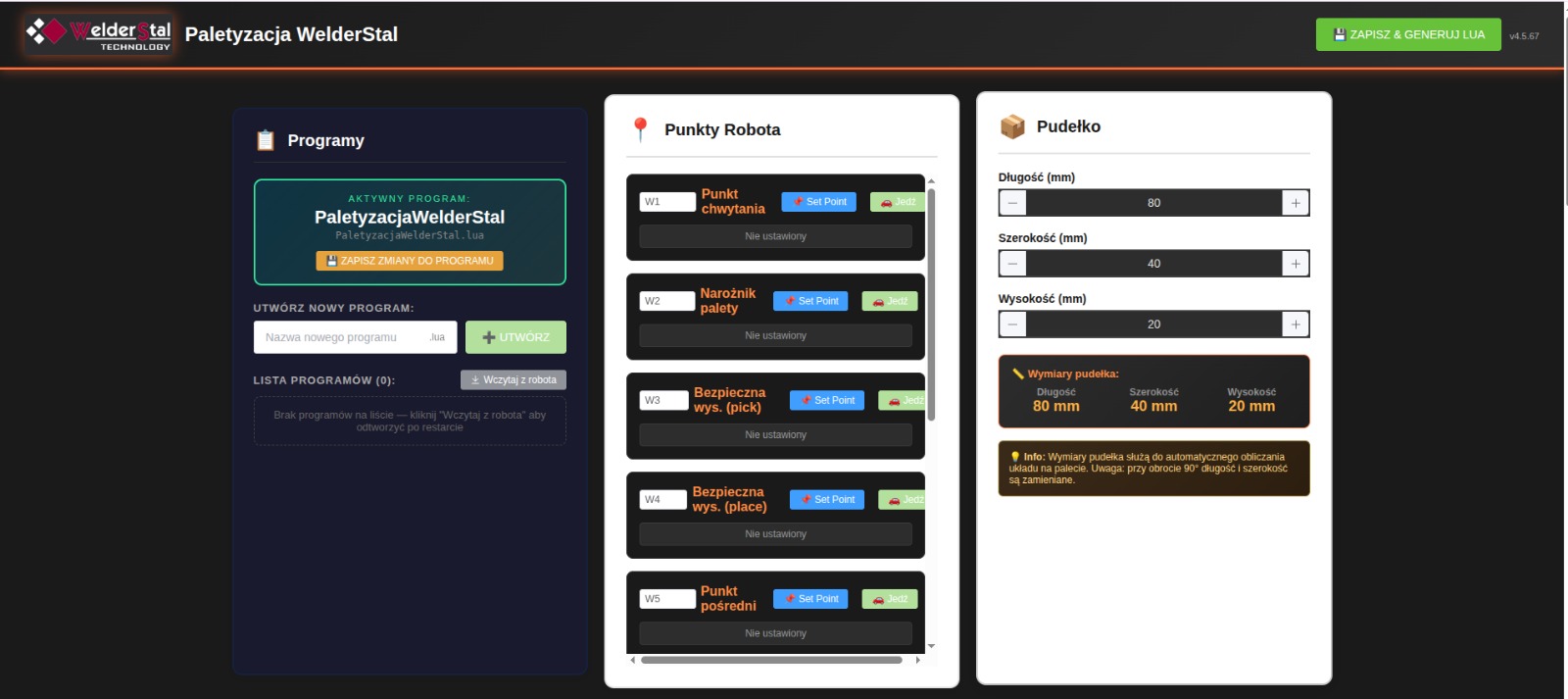
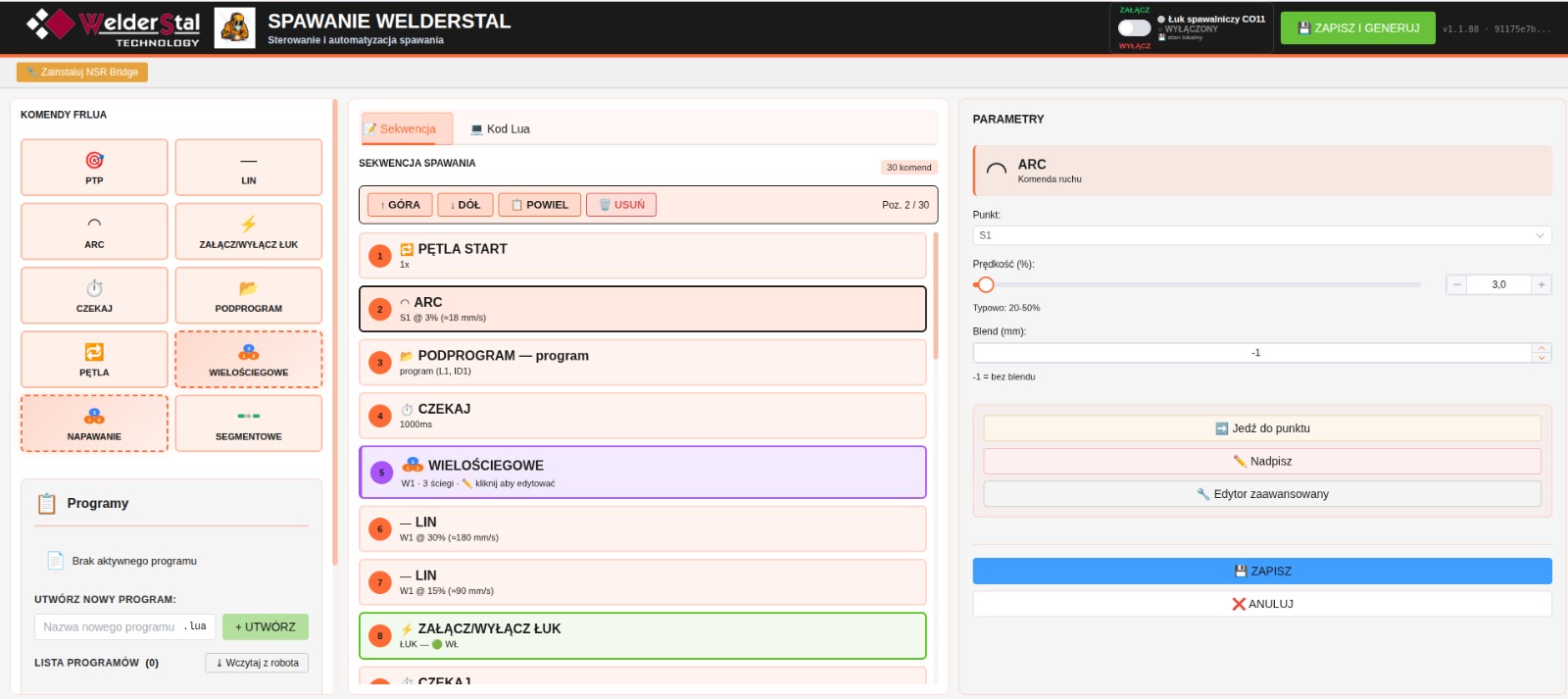
Plugins show that a WS cobot is more than a Fairino FR arm

Welderstal plugins simplify everyday operation of the cell. The operator works with prepared points, parameters and process layouts instead of starting the configuration from scratch at every change.

Welding plugin

The plugin shows that Welderstal supplies not only the Fairino FR arm but also tools for everyday operation of the cell.

Palletising plugin

For palletising the operator works with product, pallet, layer and point parameters instead of starting programming from scratch.

What the cost of a cobot kit depends on

We do not give one price for every cell, because the same Fairino FR base may need a completely different tool, integration, safeguards and commissioning scope.

01

Fairino FR model, required payload, reach and mounting method

02

Gripper, torch, holder, fixture, table, positioner or other tool

03

Plugins, configuration, points, parameters and the operator’s workflow logic

04

Safeguards, cell layout and risk assessment

05

Part tests, gripping trial, welding trial or cycle check

06

Operator training, documentation and the scope of support after commissioning

That is why without process data only an indicative cost range can be given. A more precise answer is possible only after describing the part, the cell, the pace and the required equipment.

We assess safety for the whole cell

A collaborative robot can work close to the operator, but safety depends on the whole cell: the tool, the gripped product, motion, speed, the workplace and other machines nearby.

In practice we check

01

The motion path of the Fairino FR arm and the tool

02

The product, gripper, torch or other equipment

03

Speed, forces, weight and possible collisions

04

Operator access and the operation of other machines

Frequently asked questions about cobots and WS kits

What is the difference between a Fairino FR arm, a WS cobot and a kit? +

These are three levels. The Fairino FR arm is the base of the collaborative robot. The WS cobot is the arm with a tool, equipment, plugins, configuration, commissioning, training and support. The kit is the whole cell: a WS cobot plus the process tool and, if the process requires it, an external axis or line equipment.

Can a cobot always work without guarding? +

You should not assume that. Safety is assessed for the whole cell: tool, product, speed, forces, the operator’s workplace and the surroundings. Only after the assessment can the right safeguards be selected.

When does a cobot make sense in production? +

Most often when the process is repeatable, the part or product has stable parameters and the operator performs many similar movements. It is also worth checking pace, space, format variability and how the item is fed in.

When might a cobot not be enough? +

Very high pace, too much weight, unstable products, lack of space, high process variability or a task that requires a major line rebuild can be a problem. That is why we start with a process assessment.

What does the cost of a cobot cell depend on? +

The cost depends on the WS model, the tool, gripper or torch, fixturing, safeguards, plugins, tests, integration, training and the scope of support. A single price without knowing the process would be misleading.

Do I need to know which WS model to choose? +

No. The model is selected after a process analysis. To start, it is enough to describe the part, product, pace, feeding method, space at the cell and the expected result.

Does Welderstal help after the cell is commissioned? +

Yes, support after start-up is part of the discussion about the deployment scope. It covers handing over the operating rules to the operators and agreeing a technical contact path.

What is best to send for a first assessment? +

To start, a short process description, the weight and dimensions of the item, the expected pace, the number of shifts and information about the space at the line are enough. We will arrange photos or a video of the current cell by email or phone.

Next step

Send your process for assessment

Describe the part, product, packaging, current way of working, pace, space at the cell and the expected result. On this basis we can select the WS model, equipment, plugins and commissioning scope.