When this configuration makes sense
- ✓Repeatable batches of parts with torch access to the weld
- ✓Companies that want to use a compatible MAG power source
- ✓Cells where the whole weld fits within the working envelope of the chosen arm
A WS cobot matched to the process, a cell ready for a MIG/MAG welder.
A complete welding cell base, ready to integrate with your MIG/MAG power source or a source selected by Welderstal. We match the WS cobot model to the kit - any model in the family fits.
Arm payload
3–30 kg
Arm reach
622–1900 mm
MIG/MAG cable
5 m
Cell base
Magnetic foot or PIN 28
The base variant works well for batches that can be fixtured securely and handled within the arm’s working area. It needs no track or part rotation, provided the torch can reach the whole weld in a properly designed cell.
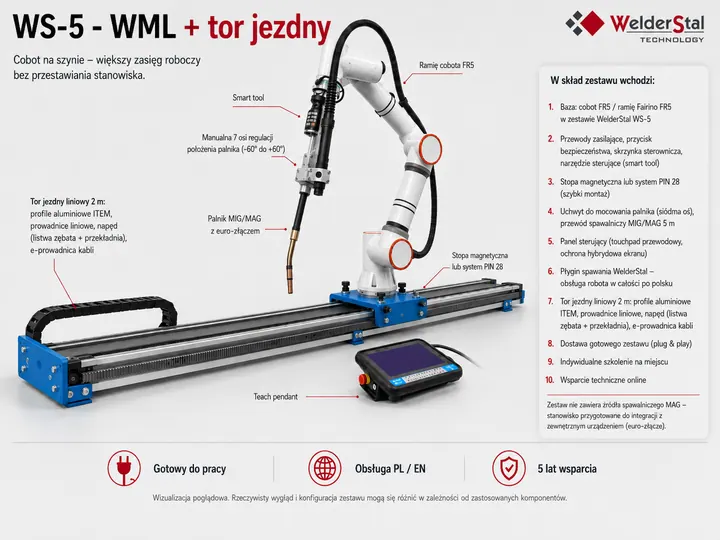
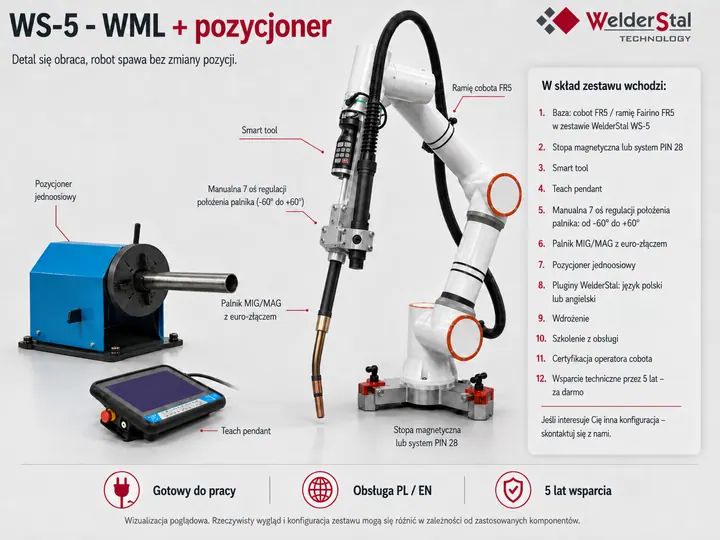
No arm can replace secure fixturing or create torch access where there is none. Long parts and circumferential welds need an additional axis - a linear track or a positioner.
The photo shows the cell at work: the cobot guides the torch along a programmed path. The kit consists of the five components shown on the board at the top of the page - the arm, smart tool, manual seventh axis for torch adjustment, MIG/MAG torch with a Euro connector and the cobot base. The magnetic foot applies to the variant with the WS-5 arm; the kit with the WS-5 WML works on the PIN 28 system. The lists below separate the scope of delivery from what we select for the cell.
Any cobot in the WS family fits the welding kit. We match the model to the part, reach and cycle time - the rest of the kit stays the same.
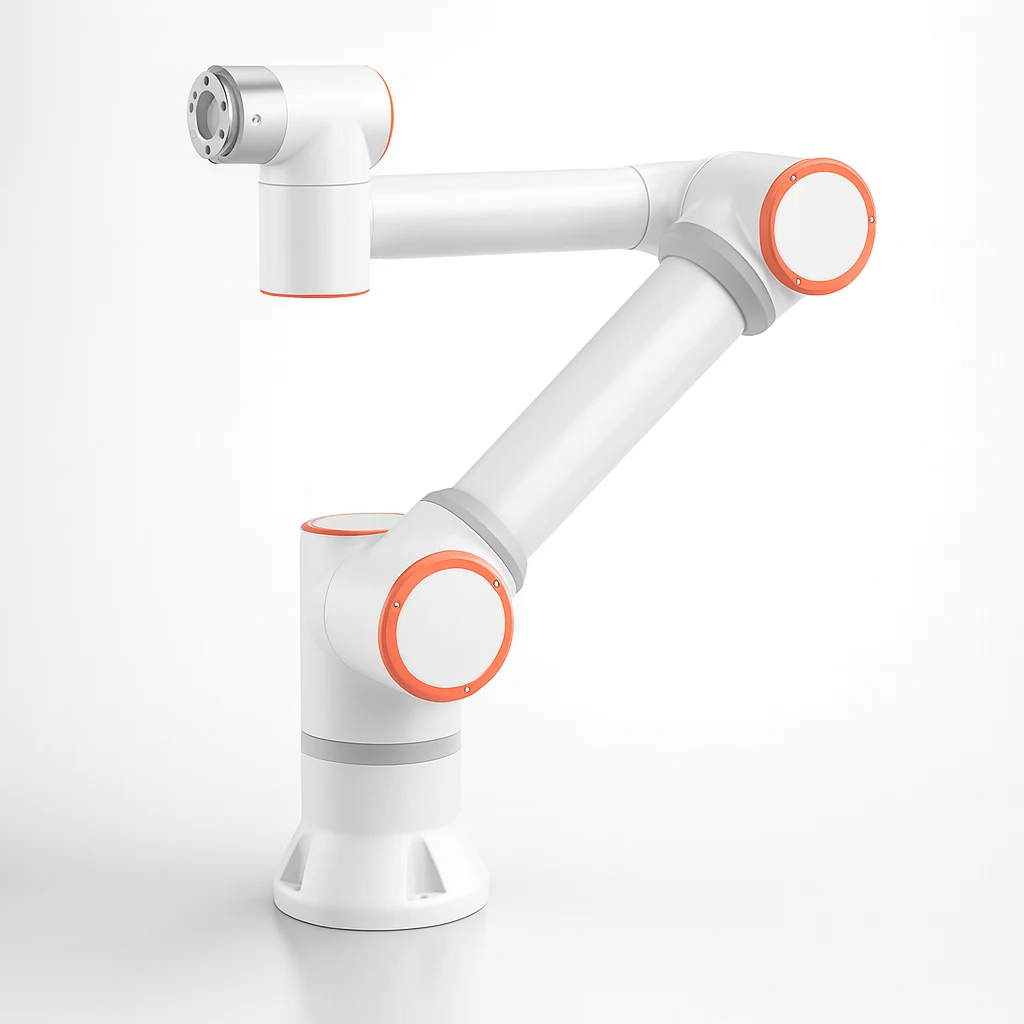
WS-3
Fairino FR3
Magnetic foot or PIN 28
WS-3 WMS
Fairino FR3-WMS
PIN 28 system
WS-3 WML
Fairino FR3-WML
PIN 28 system
WS-5
Fairino FR5
Magnetic foot or PIN 28
WS-5 WML
Fairino FR5-WML
PIN 28 system
WS-10
Fairino FR10
PIN 28 system
WS-16
Fairino FR16
PIN 28 system
WS-20
Fairino FR20
PIN 28 system
WS-30
Fairino FR30
PIN 28 system
The base variant does not include a MIG/MAG power source. We check whether your welder can be connected via a Euro connector, or we select a suitable power source separately.
The cobot has to return to the same position relative to the part. The longer the arm, the greater the moment on the base - which is why the mounting method in the kit is not arbitrary.
With a 1900 mm reach, a magnetic foot cannot hold the cell base. That is why we supply the WS-5 WML kit on PIN 28 locating pins. After repositioning, the cobot returns to the same base and the program needs fewer corrections.
Only the short arms - the WS-3 and WS-5 - work on the compact magnetic foot. It attaches to a steel surface without tools, so it is the choice for cells moved between workplaces. A larger cobot needs a PIN 28 base.
The welding kits share the same plugin and the same choice of arm. What sets them apart is the external axis and the joining process. The choice depends on the part geometry, not on the arm’s reach alone.
| Kit | When it makes sense | External axis |
|---|---|---|
| Basic kitYou are here | Repeatable parts that fit within the arm’s working envelope. | No additional axis |
| WS kit + linear track | Long structures or several workstations in one line. | External 2 m linear axis |
| WS kit + positioner | Circumferential welds on pipes, sleeves and shafts. | External rotary axis |
| Laser welding kit | A process qualified for laser: welding, cleaning or cutting. | Separate architecture and training |
| Palletising kit | Stacking cartons, bags and containers from the end of the line onto a pallet. | Column-mounted cobot, guarding and conveyor |
We do not select a kit from the catalogue alone. The order is the reverse: first we check the part and the process, and only then the cell configuration.
We check the geometry, weld, material, fixturing, cycle time and available space.
We set the path, torch position and the way the cell works with the MIG/MAG power source.
We prepare the configuration, assembly, calibration and commissioning on the customer’s site.
We train staff to operate the cell and provide five years of technical support.
Five pieces of information are enough to start a conversation about a specific cell. We will arrange photos and drawings of the part by email or phone.
Weld type and length
Material and thickness
How the part is fixtured
Batch size and work pace
Space available for the cell